Average Cost of Assisted Living in Melbourne, FL
A practical look at Melbourne-area assisted living costs, what monthly fees may cover, and how to compare care options and plan a family budget.
Families researching the average cost of assisted living in Melbourne, FL, need a local benchmark before they can compare individual quotes. A median is a midpoint, not the rate every resident pays, and it is not a price quote for Martha’s House.
How the average cost of assisted living in Melbourne, FL compares
For families using the phrase “average cost,” it helps to know that rather than a single market-wide average. Its Melbourne-area, Florida and national benchmarks provide a consistent starting point for both monthly and yearly planning.
Those gaps describe broad market benchmarks; they do not measure differences in rooms, services or care needs. The annual column translates the same benchmarks into a yearly planning view. A family’s actual yearly total will depend on its contract, care plan and any separately billed charges.
What a monthly assisted living fee usually covers
An assisted living quote may combine housing and care, but the bundle is not identical everywhere. A monthly fee often includes a room, meals, housekeeping, laundry, maintenance and help with activities such as bathing or dressing. A residential home and a large campus may organize those services differently, so the setting alone cannot explain the price.
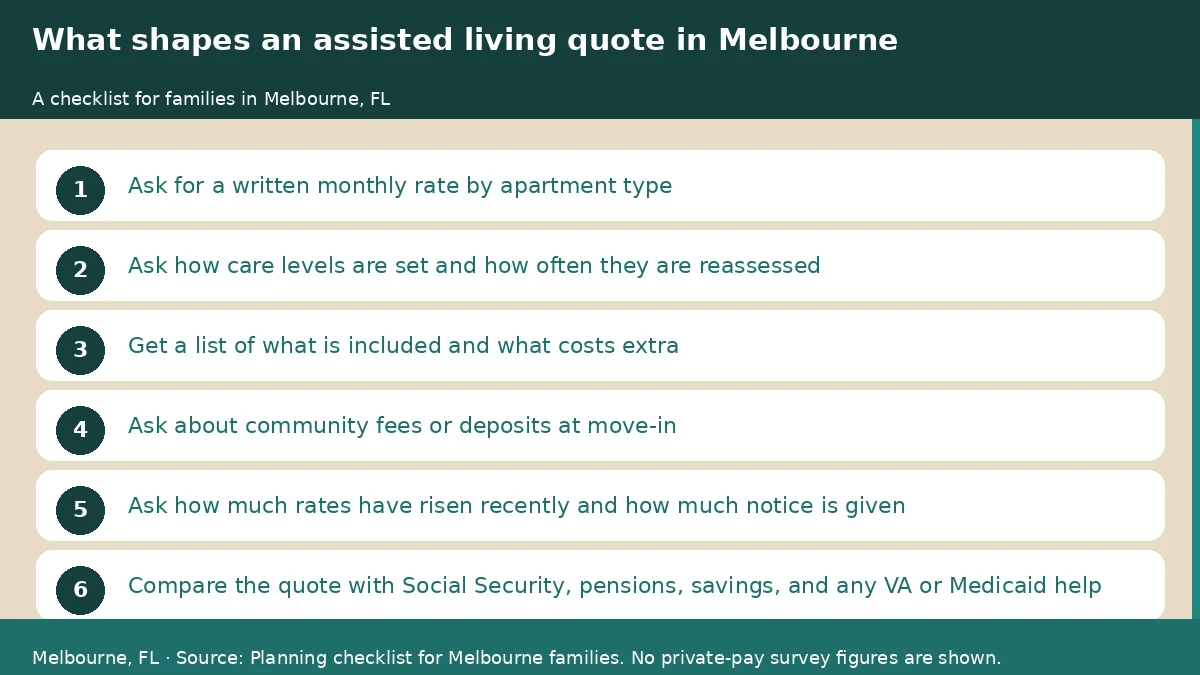
Ask for a written service list and an itemized sample quote. Useful questions include:
- Which meals, housekeeping, laundry, transportation and personal care services are included?
- Are medication support, incontinence supplies or higher levels of assistance billed separately?
- Are there assessment, community, deposit or other one-time charges, and are any refundable?
- What happens to the room and the bill if care needs change?
Families exploring assisted living in Melbourne should compare the written service list, not just the headline rate. The lowest initial quote is not necessarily the lowest total once separately billed items are added.
Why individual quotes vary
Room type is one variable. A private room may be priced differently from a shared arrangement, and a larger space may carry a different rate. Care level is another. Someone who needs occasional reminders may have a different service plan from someone who needs hands-on help throughout the day. Changes in mobility, continence, eating, dressing or behavior can prompt a reassessment.
Memory support may also change the comparison. Memory care should be discussed in terms of supervision, assistance with routines and the living environment, not as a promise to change the course of dementia. Ask how care plans are reviewed and what would happen if needs exceed what a residence can support.
The building model matters too. A small residential home and a large community may organize dining, activities, transportation and staff coverage differently. The useful comparison is a written quote prepared for the same prospective resident, using the same service assumptions, alongside each provider’s policy for future changes.
Comparing assisted living with care at home
These illustrations show how sensitive a home-care budget is to the schedule. They are not quotes from a local agency, and they do not capture every household expense.
Adult day support may help while a person continues living at home, but it does not replace overnight supervision. A balanced comparison should include housing, food, utilities, maintenance, transportation, backup coverage and the hours family members provide without pay.
Nursing home costs answer a different care question
These numbers should not be used to choose a level of care on price alone. Nursing homes and assisted living serve different needs. For budget planning, the figures show why a current quote should include a discussion of possible future needs and transfers, rather than assuming one setting will fit indefinitely.
What may help pay for care
Medicare and long-term care insurance
Medicare’s long-term care guidance says Medicare does not cover long-term custodial care if that is the only care needed, and most long-term care is custodial. Families should not assume that an assisted living monthly fee will be reimbursed by Medicare.
Long-term care insurance may pay for assisted living, depending on the policy. Benefits generally begin after an elimination period and when the policyholder needs help with daily activities or has cognitive impairment. Review covered settings, benefit limits, exclusions, documentation requirements and payment procedures with the insurer.
VA pension benefits
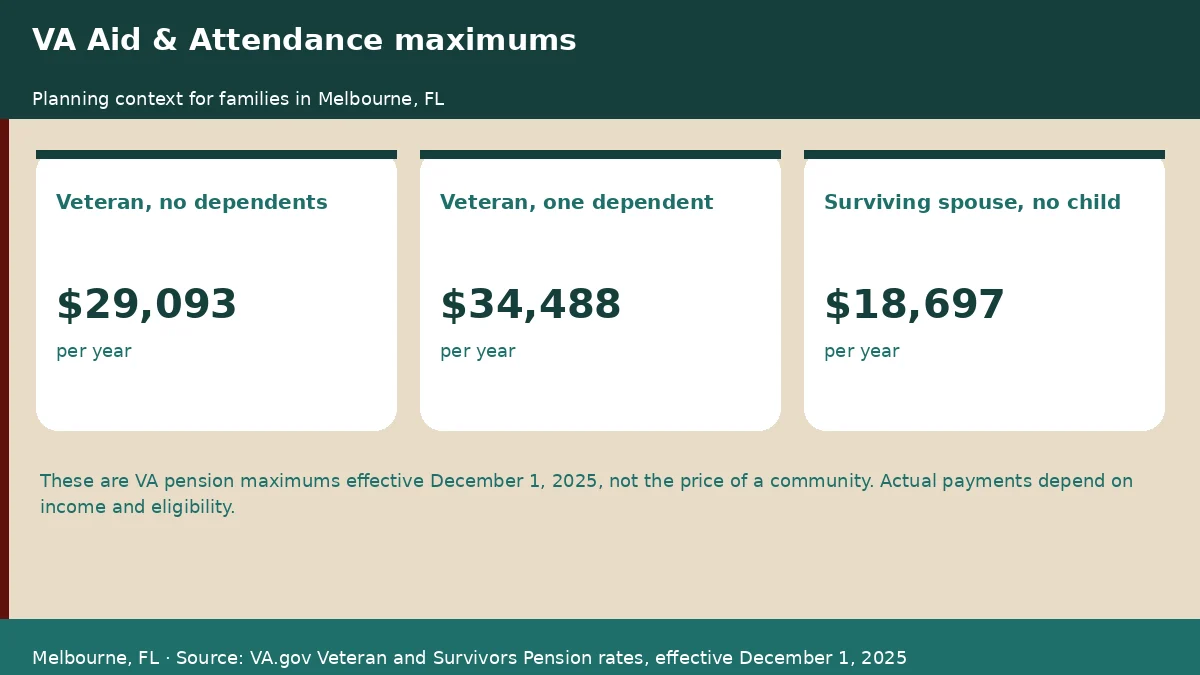
VA Aid and Attendance can increase a VA pension for eligible wartime-era Veterans or surviving spouses who meet criteria such as needing help with daily activities. Current VA pension rates list a Maximum Annual Pension Rate with Aid and Attendance of $29,093 for a Veteran with no dependents and $34,488 for a Veteran with one dependent. They are maximum illustrations, not guaranteed payments.
The VA net worth limit from December 1, 2025 through November 30, 2026 is $163,699. The pension is the applicable maximum rate minus countable income, and VA considers documented unreimbursed medical expenses under its rules. VA also reviews certain asset transfers, so obtain qualified guidance before making financial changes.
Florida Medicaid long-term care
Florida’s Statewide Medicaid Managed Care Long-Term Care program can cover assisted living services, personal care, adult day care and respite for eligible people who need a nursing facility level of care. Enrollment is limited and there is a waitlist. Screening begins through the local Aging and Disability Resource Center, so eligibility and timing should be investigated before care funds become urgent.
Licensing, memory support and respite in Florida
Florida’s Agency for Health Care Administration licenses assisted living facilities. Its Assisted Living Unit guidance also describes specialty license types and dementia-related staff training requirements for facilities that advertise memory care. Families can ask for licensing and inspection information instead of relying only on marketing language.
Respite serves a different purpose from a permanent move. The National Institute on Aging describes respite as a short-term break for family caregivers, provided at home, through adult day centers or during short residential stays. Ask separately about availability, length of stay, assessment requirements and how a respite rate is structured.
Questions to ask about rates and rate increases
Before selecting a residence, ask for clear answers and keep them with the written quote:
- What is included in the base monthly rate for this room and the current care plan?
- Which changes trigger a reassessment or a different care level?
- How are added care charges calculated, and will statements itemize them?
- When was the base rate last changed, how often are adjustments considered, and how much written notice is given?
- Are there separate charges for supplies, transportation, special diets, laundry or another occupant?
- What are the policies for absences, discharge, refunds and a change in payer source?
- What happens if a resident’s needs eventually exceed the services the residence can provide?
For families touring around Viera, Suntree, Rockledge, Wickham Road and Interstate 95, using one worksheet can make otherwise different proposals easier to compare. Martha’s House is at 3831 Funston Circle in Melbourne and offers assisted living, memory care and respite in a residential home setting. Families should contact the residence for current rates, availability and a written description of included services.
The metro median supplies context. The care plan, contract, rate-increase policy and people providing daily support supply the details needed for a sound decision.
Frequently asked questions
What is the average monthly cost of assisted living in Melbourne, FL?
A median is a market midpoint, not a guaranteed rate or a quote from Martha’s House. Room type, care needs and separate charges can change an individual price, so request a written quote for current rates.
Is assisted living in Melbourne cheaper than home care?
Home budgets also need to account for housing, food, utilities, maintenance, transportation and any unpaid family caregiving.
Does Medicare pay for assisted living in Melbourne?
Medicare does not cover long-term custodial care when that is the only care needed, and most long-term care is custodial. That means Melbourne families should not assume Medicare will pay an assisted living monthly fee. Long-term care insurance may help, depending on the policy’s benefit triggers, elimination period, covered settings and limits. Review the actual policy and ask the insurer to explain benefits in writing.
Does Martha’s House offer memory care and respite in Melbourne?
Yes. Martha’s House offers assisted living, memory care and respite in a residential home setting at 3831 Funston Circle in Melbourne, on the Viera and Suntree side of the city. Memory care should be understood as supervision, daily support and an appropriate environment, not a promised change in dementia. Respite provides a short-term break for caregivers. Ask directly about current availability, rates and whether the setting fits the person’s needs.
Can VA benefits or Florida Medicaid help Melbourne families pay for assisted living?
Eligible wartime-era Veterans and surviving spouses may qualify for VA Aid and Attendance as an addition to a VA pension, but the amount depends on eligibility and countable income. Florida’s Medicaid long-term care program can cover assisted living services for people who meet medical and financial requirements, though enrollment is limited and there is a waitlist. In Brevard County, screening starts through the local Aging and Disability Resource Center.
Talk with Martha's House
If you are weighing care options in Melbourne, call (321) 978-5315 or contact and tours. Our team can talk through current availability, rates and next steps. Please confirm all details directly, since published figures and listings change over time.
Sources
- VA Aid and Attendance and Housebound benefits
- VA pension rates (current)
- Medicare: long-term care coverage
- National Institute on Aging: What is respite care?
- ACL: What is long-term care insurance
- Florida AHCA: Assisted Living Unit
- Florida AHCA: Statewide Medicaid Managed Care Long-Term Care Program
Program rules and benefit amounts were checked on the linked official pages in November 2026 and can change.
Related reading on this site: